
Which patient populations and service lines are most exposed to potential Medicaid coverage losses in 2027?
Give your entire health system an AI advantage without exposing PHI.
Create a synthetic, de-identified digital twin of your patient population with Subsalt so analytics, quality, and strategy teams can spend more time exploring questions and less time waiting for data.
Expert Determination certification by Datavant included.
The teams that run your health system have questions.
Not every question requires data with patient identities. Give analytics, quality, strategy and marketing teams a digital twin for faster, safer exploration without extended committee reviews that delay progress.
More approved work
Give authorized teams a repeatable path to de-identified exploration and aggregate analysis.
PHI stays protected
Patient data remains in its approved environment. Users work with the digital twin and de-identified results.
Privacy evidence included
De-identification documentation covers the method, controls, and residual-risk assessment.
Which TEAM surgical episodes are followed by readmissions or ED visits within 30 days?
Quality
Where are we losing surgical volume to ambulatory surgery centers or competitors?
Strategy
Did new-patient volume increase for a service line after last quarter’s campaign?
Marketing
How Subsalt powers a learning health system
Scroll to follow patient data through Subsalt, from source PHI to answers your teams can use.
01
Start with your patient data.
Subsalt is deployed on Kubernetes inside your protected environment. After you connect your patient data, Subsalt analyzes its structure and assesses re-identification risk, with third-party evaluation by Datavant.
02
Create your synthetic digital twin patient population.
Subsalt creates synthetic patient data, preserving health patterns for analysis without exposing patient identities. Refresh the twin data at your discretion. Your synthetic twin meets the HIPAA Privacy Rule requirements through Expert Determination under 45 CFR § 164.514(b)(1).
03
Connect AI to Subsalt and ask questions with chat.
Approved teams ask questions through connected AI tools. Subsalt determines whether each answer needs row-level data or aggregates, then returns synthetic records from the digital twin or de-identified aggregate results from source PHI through Secure Runtime. Users never see or interact with PHI.
04
Or explore patient data with SQL and generate charts with Python.
Analysts and researchers can explore the synthetic twin with SQL, then run Python code against source PHI in Secure Runtime to create charts and other visualizations. These reflect aggregate results from your actual patient population. All outputs are de-identified before they are returned.
05
Refresh your synthetic digital twin on demand.
Update your twin as often as your use cases require, so research and answers reflect what’s affecting your patients’ health this month or quarter.
 ChatGPT
PatientRecordAgeAgeSexSexDiagnosisDiagnosisA1cA1cBMIBMI
Maria OrtegaTwin 2081 6461 FF Type 2 diabetesType 2 diabetes 7.98.1 31.230.4
James WhitfieldTwin 0457 6872 MM Type 2 diabetesPrediabetes 8.46.3 28.727.9
Aisha BelloTwin 1730 4649 FF PrediabetesType 2 diabetes 6.17.6 33.532.1
Robert KimTwin 0962 5557 MF Type 2 diabetesType 2 diabetes 7.28.7 26.429.8
Linda NovakTwin 3315 7366 FM Type 2 diabetesType 2 diabetes 8.87.3 29.927.2
A1c distribution · synthetic sample
4%6%8%10%12% A1c
A1c, source
A1c, twin
Which age group has the most patients with type 2 diabetes above an A1c of 8?
Searched the De-Identified Digital TwinSearching the De-Identified Digital TwinSubsalt MCP
Patients aged 65 to 74. About 38% of that group has an A1c above 8, compared with 24% across all ages.
Your analysis Monthly mean A1c · type 2 diabetes
- Sent to Secure Runtime
- Ran on the original PHI
- Output checked
- Result returned
De-Identified Digital Twin
Refresh your population
Source data available throughSep 30, 2026
Twin snapshotOct 31, 2025Update available
Synthetic recordAgeA1c
Twin 2081618.1
Twin 0457726.3
Twin 1730497.6
Twin 0962578.7
New source data is ready for your next refresh.
Make patient de-identification defensible in the age of AI.
When health systems need to share data externally, de-identification is often the solution. But as frontier AI models advance, so does inference, and Safe Harbor de-identification becomes increasingly risky.
Removing 18 columns of data to meet Safe Harbor classification is no longer enough. Protect patient privacy and keep secondary use initiatives defensible with Subsalt.
Certified by Datavant
Datavant has certified Subsalt’s de-identification technology across both components of the platform: the De-Identified Digital Twin and Secure Runtime.
Every query tested
Automated privacy tests govern what can leave Secure Runtime. Datavant reviewed those tests as part of its evaluation.
Committee-ready evidence
De-identification documentation accompanies the outputs covered by the determination, so privacy and compliance teams can see the method and the assessment.
“Subsalt demonstrated a clear commitment to data privacy through their active collaboration with our team.”
Free your top data-driven initiatives from committee purgatory.
Unblock AI, research, and collaboration with de-identified data.
Once data meets HIPAA’s de-identification standard, it is no longer PHI and is no longer subject to HIPAA’s restrictions on use and disclosure. Here are the top initiatives our customers are unblocking with Subsalt.
Keep general-purpose AI out of PHI
Give your workforce an approved way to ask questions of patient data without resorting to shadow AI. General-purpose AI tools connect through Subsalt MCP, returning synthetic records or de-identified aggregate answers without exposing PHI.
Advance in-house AI innovation
Give AI teams governed data for model development, evaluation, and monitoring, without expanding PHI exposure.
Accelerate research
Shorten the path from research question to analysis-ready results. Reuse a consistent, de-identified environment instead of recreating access for every study.
Support network collaboration
Support data collaborations with academic, technology, and life-sciences organizations using a repeatable, privacy-preserving pattern.
Diversify data governance
Use established review pathways when work requires identifiable patient data. When patient identities aren’t needed, choose a faster path with Subsalt’s de-identified data.
Create data products
Create a governed path to direct data partnerships and new revenue while retaining data ownership and keeping PHI inside your security boundary.
Rethink access.
Retain oversight.
Explore how de-identified access can support AI, research, and analytics while your institution retains control of permitted use and disclosure.
Read the white paper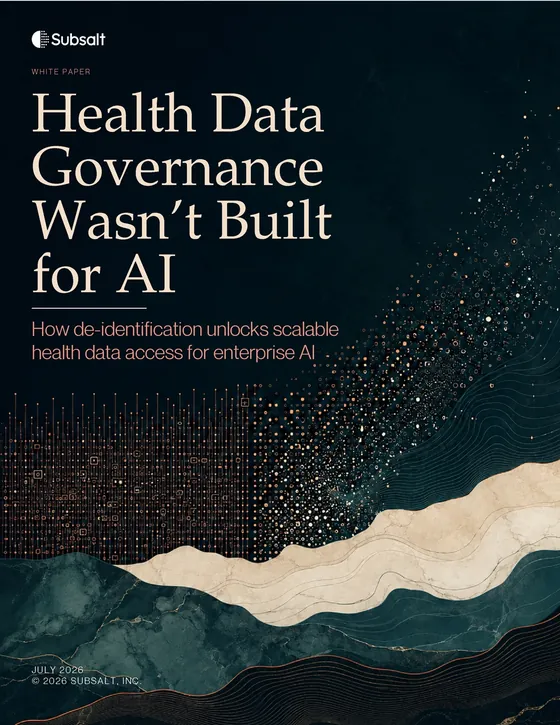
Trusted by teams advancing health system AI and research



Give your biggest initiatives a faster, safer path to data access.
Bring us the initiative currently waiting on access. We’ll show you how Subsalt changes the path forward.
Questions? We’ve got answers.
Does all of our data have to be de-identified?
No. Your health system chooses which tables and datasets go into the De-Identified Digital Twin. Most organizations start with the data one initiative needs, then add more as new use cases come up. Source PHI stays where it is, inside your environment.
How current is the De-Identified Digital Twin, and where does the data live?
The twin reflects your source data as of its most recent refresh. Your health system sets how often that refresh happens. Source PHI stays inside your environment the whole time. When analysis runs in Secure Runtime, it runs against your current source data, so final results reflect the latest records.
What is Subsalt, and how does it help health systems use PHI safely?
Subsalt is a privacy-preserving platform for health system data. It generates a De-Identified Digital Twin of your structured EHR data under the HIPAA Expert Determination method. Approved users explore the twin, then run analysis against source PHI in Secure Runtime. They get de-identified aggregate results, not row-level patient data, so your health system can support AI, research, and analytics without broadly exposing PHI.
How does Subsalt fit into our existing healthcare data architecture (EHR, data warehouse, cloud)?
Subsalt connects to your enterprise data warehouse, EHR exports, and registries through standard interfaces. It runs inside your existing on-prem or cloud environment. PHI stays within your health system’s security and compliance boundary. Subsalt adds a governed layer for de-identification and aggregate analytics, without creating a new data silo.
How does Subsalt support HIPAA-compliant de-identification and Expert Determination?
Subsalt uses the HIPAA Expert Determination method, evaluated by Datavant, rather than relying only on Safe Harbor. De-identification documentation accompanies the outputs covered by the determination. It documents the dataset, transformations, residual-risk assessment, and assumptions. That gives privacy, legal, and compliance teams defensible evidence that de-identification meets HIPAA’s “very small risk” standard for the intended use.
How is Subsalt different from a traditional de-identification tool or data warehouse?
Traditional tools typically produce a single de-identified dataset and hand it to analysts. Subsalt provides a governed environment instead. Users explore the De-Identified Digital Twin through SQL or compatible AI chat, then run approved analysis against source PHI in Secure Runtime. The result is repeatable, privacy-preserving access to health system data, without distributing row-level records.
Who can access Subsalt, and what types of results can they see?
Access is role-based and project-based. Approved researchers, analysts, AI teams, and clinicians can explore the digital twin and submit analysis. Subsalt returns aggregate outputs such as counts, rates, summary tables, cohort metrics, and charts. These suit research, quality improvement, posters, and internal reports. Subsalt never returns raw patient data.
How does Subsalt help with AI in healthcare (model development and validation)?
Subsalt gives AI teams a governed path to model-ready data. They can understand cohorts, features, and outcomes from the digital twin, then validate performance with aggregate metrics computed from source PHI in Secure Runtime. Models and external tools never see raw PHI, which helps health systems align AI initiatives with data governance and privacy requirements.
Can Subsalt help us accelerate clinical research and multi-site studies?
Yes. Subsalt shortens the path from research question to analysis-ready results by reusing a consistent de-identified environment for cohorts and queries. Investigators can explore data, refine hypotheses, and get aggregate outcomes more quickly. That supports academic medical centers, multi-site studies, registries, and real-world evidence programs.
How does Subsalt support health system data governance at AI scale?
Subsalt turns high-level governance policies into operational controls. Committees still decide which projects and roles are approved. Subsalt enforces de-identification, access control, and output checks consistently. That lets governance teams support more AI, research, and analytics use cases without multiplying manual data extracts and one-off privacy reviews.
How is Subsalt different from national aggregate data platforms that are already de-identified?
Those platforms pool de-identified data from many organizations into a shared national asset. That is useful for benchmarking, but it is not your population, and it does not answer questions about your own patients. Subsalt is infrastructure for a single health system. It makes the clinical data you already own usable under your own governance, security, and partnership strategy. You never contribute it to a shared marketplace or cede control of your PHI.
Where should a health system executive team start with Subsalt?
Most organizations begin with one initiative currently blocked by data access. That might be a research program, an AI project, a strategic partnership, or a quality-improvement effort. Subsalt sets up a De-Identified Digital Twin and Secure Runtime for that use case, shows how the path from request to result changes, and then scales the same capability across other data initiatives.
Do I need a lot of extra storage for my Subsalt digital twin?
No. Subsalt can generate synthetic data at query time, so you do not have to store a separate synthetic dataset. You also have the option to cache synthetic data behind the endpoint for faster retrieval, in milliseconds rather than minutes. Neither approach requires a lot of extra storage.
Does Subsalt connect to the EHR?
Subsalt connects to your data warehouse, such as Snowflake or Databricks, rather than directly to your EHR. It works with the patient data your health system already brings into that warehouse.
Have an initiative waiting on data access? Bring it to Subsalt.
Request a meeting